
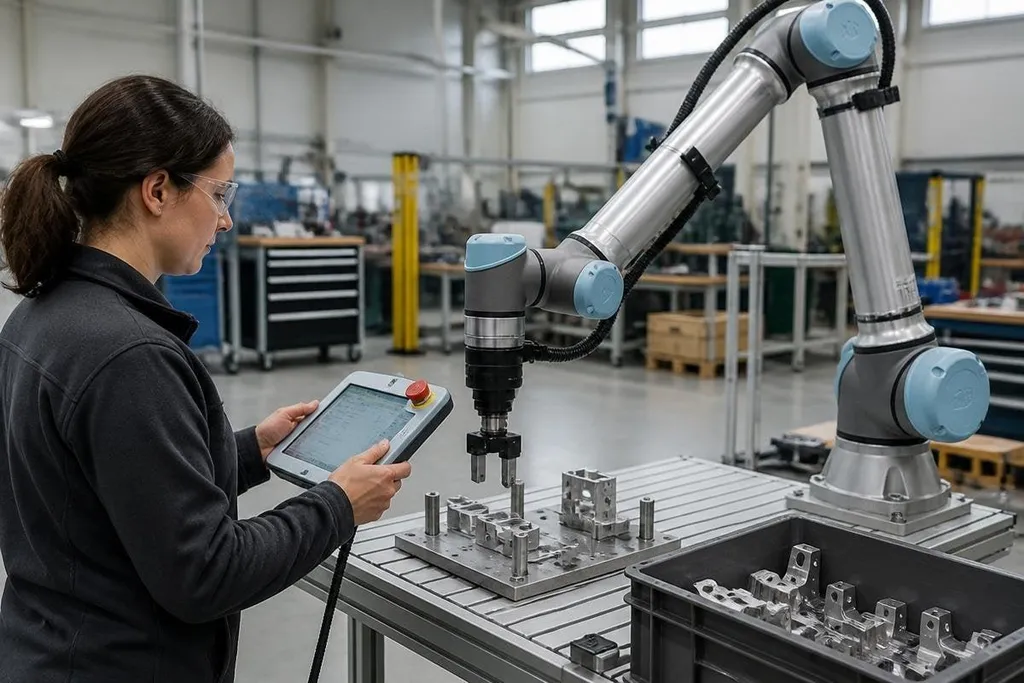
A collaborative robot, or cobot, can work near people while handling a repeatable task such as loading, fastening, sanding, or inspection. That gives small manufacturers and service firms a way to sell automation without building a fully separate robot cell for every job.
The business opportunity sits in the work around the arm. A company can sell the robot, set it up, write the task software, train staff, or run the service for the customer.
- Cobots fit tasks that need steady repetition beside a human worker.
- Integrators can earn from grippers, cameras, safety checks, and setup.
- The customer still needs a clear task, a safe work area, and a payback case.
1. Build small automation cells
Many factories have tasks that repeat for part of a shift but change when the product changes. The arm can load a machine, place parts in a fixture, apply adhesive, or move finished pieces to a tray while a person handles quality checks or material supply.
That creates room for small automation cells built around one task. The seller may supply the arm, end effector, fixture, control panel, and safety equipment as one working package. The customer gets a defined piece of production rather than a general promise about automation.
Task choice is the hard part. A cobot suits work with a stable sequence, known part locations, and a clear handoff. It fits poorly where part positions shift between units, surfaces change, or the person must make a judgment on every piece.
2. Sell integration and task software
A robot arm rarely works alone. It needs a gripper to hold the part, sensors to check position, software to send commands, and a safe way to stop when a person enters the work area.
An integrator can make money by joining those pieces and tuning the system for one customer. The work may include mapping inputs and outputs, setting robot paths, connecting a machine controller, and writing the screen used by operators.
Each task has its own failure points, so a reusable setup can cut the time needed for later jobs.
A cobot service depends on the arm, the task, and the software around it. Robot24.com robotics coverage reports on the machines, automation firms, and technical changes behind those services, giving you facts to check before building tools for changing production.
3. Create tools for changing production
A cobot becomes easier to sell when it can move between tasks. That depends on quick tool changes, simple programming, and fixtures that can be adjusted without rebuilding the whole cell.
A supplier could focus on modular grippers, part trays, camera mounts, or software that helps staff switch jobs. The value comes from reducing setup work between batches. A factory that makes short runs may care more about changeover time than the robot’s maximum speed.
This path needs close contact with operators. A tool that looks good in a demo may jam when parts arrive with small variations. A camera that finds one cleanly placed object may struggle when a bin is half empty.
4. Run robots as a service
Some companies may prefer to pay for completed work rather than buy the equipment. A service provider could install a cobot, maintain it, replace worn tools, and charge by shift, part, or month.
That model moves some cost and repair work away from the factory. It also gives the provider responsibility for uptime, training, spare parts, and safe operation. The contract needs a clear task definition, since a robot that loads one machine may not handle a second model without new fixtures or software.
I’d focus on one repeatable task and one type of customer before offering a broad robot service.
A practical check before spending money
Use this list to test whether a business idea has a real path to revenue:
- Name the task: write down each human step, part size, cycle, and handoff.
- Check the variation: record how often parts, tools, or product models change.
- Price the full cell: include the arm, gripper, fixture, sensors, software, training, and maintenance.
- Set the safety plan: identify pinch points, stopping zones, operator access, and required checks.
- Pick the buyer: decide if the customer pays for equipment, setup work, or completed output.
- Test the payback: compare the full project cost with the labor, scrap, downtime, or missed orders it may affect.
A sound cobot business starts with a narrow job that can be measured. The next useful question is not how many robots a company can sell, but how many repeatable tasks it can keep running safely for one customer.